
A FREE ASSESSMENT FOR RUNNERSTHE ALIGNMENT MAP
You know your pace. You know your mileage. How well do you know the body producing them?
The Alignment Map uses ten Classical Pilates exercises to show you how your body organizes strength, mobility, control and coordination. You may discover where your limbs can move independently, where your body starts compensating, and where your training deserves more attention.
This isn't another workout. It's an assessment.
Move through each exercise slowly. This isn't about how big, fast, or advanced you can make the movement. Pay attention to what your body has to change in order to accomplish it.
Your range ends where your control ends.
10 EXERCISES • CLASSICAL PILATES • BUILT FOR RUNNERS • NO EQUIPMENT
01. The Hundred
How far can your limbs move away from your center before your trunk has to change?
Lie on your back and pull into a tight little ball, balancing across the four corners of your torso.
Stretch your legs to 90 degrees and hover your hands so your arms are parallel to the mat.
Begin reaching your legs forward. Stop at the last point where you can keep your back firmly connected to the mat.
Hold everything from the crown of your head through your feet completely still as you pump your arms up and down.
Inhale for five pumps. Exhale for five.
GOAL
Maintain a strong, stable center while the arms and legs move away from it.
CHECK YOURSELF
Did your back stay connected to the mat as your legs reached away? Could you move your arms without moving the rest of your body?
WHY IT MATTERS FOR RUNNERS
Running asks your arms and legs to move continuously around a relatively organized center. Your limbs create movement; your trunk has to manage it.
THINK ABOUT IT
Can you move your arms and legs without losing your center?
YOUR ALIGNMENT MAP TAKE AWAY
Lower isn’t better.
Your Hundred reveals: how well can your center support increasingly long levers?
02. Roll Up
Can you articulate your spine without losing the organization of your upper body?
Lie on your back with your knees bent and feet anchored through the big toe, little toe, and heel.
Keeping your back connected to the mat, reach your arms overhead. How far can they travel before your rib cage wants to lift?
Bring your head through the window of your arms and begin rolling up one bone at a time. Can you get up without your legs moving, your ribs collapsing, or your feet losing connection with the mat?
Once you can control the movement with bent knees, straighten your legs, flex your feet, and try again.
Pay attention: are you using your deep abdominal strength or throwing your arms forward for momentum?
Double-check yourself by trying it with your hands behind your head.
GOAL
Articulate the spine with control while keeping the legs grounded and the movement connected to the center.
CHECK YOURSELF
Where did the movement stop being spinal articulation and start becoming momentum?
WHY IT MATTERS FOR RUNNERS
Your rib cage, spine, and pelvis don't operate independently when you run. The better you can organize them together, the less your body has to borrow movement from somewhere else.
THINK ABOUT IT
Can you control your spine — or do you have to throw yourself through the parts you can't access?
YOUR ALIGNMENT MAP TAKE AWAY
Touching your toes isn’t the goal.
The assessment is noticing where your shoulder range ends and your rib cage begins compensating for it. Then, as you Roll Up, you're asking the same question in a different way: where can your body move while maintaining its organization — and where does that organization begin to change?
Your Roll Up reveals: how well can you coordinate shoulder mobility, rib-cage organization, and spinal articulation as you move against gravity?
03. Single Leg Circles
How much of your hip mobility actually belongs to your hip?
Lie flat on your back with both legs long.
Lift your right leg toward the ceiling in external rotation. Can you keep your head, neck, shoulders, hips, and opposite hamstring connected to the mat?
Tick-tock the right leg across your midline toward the left. Can you keep your right hip anchored?
Take the leg toward the right. Can you maintain the external rotation without letting your pelvis follow?
Now draw circles with the leg. Keep the rest of your body firmly connected to the mat while maintaining your external rotation and connection through your outer glute and lower abdominals.
Make the circle only as large as you can control.
GOAL
Move the leg freely through the hip joint while keeping the pelvis and trunk stable.
CHECK YOURSELF
Did your leg move inside the hip socket—or did your pelvis have to move with it?
WHY IT MATTERS FOR RUNNERS
Every stride requires your leg to move at the hip while your pelvis manages the forces traveling through it. More movement isn't necessarily better movement.
THINK ABOUT IT
How much of your hip mobility actually belongs to your hip?
YOUR ALIGNMENT MAP TAKE AWAY
Bigger circles doesn’t necessarily mean better hip mobility.
Your range ends where your control ends.
Your Single Leg Circles reveal: can your leg move freely inside your hip while your pelvis remains organized?
04. Rolling Like A Ball
Can your spine maintain its shape and track evenly along the mat?
Balance behind your sit bones and pull your knees tightly into your chest.
How deeply can you fold without putting your feet down or losing your balance?
Maintain that exact shape as you roll backward.
Roll back up without letting your legs move away from your body.
Notice what initiates the movement. Are you leading from your head and shoulders—or controlling the roll from your center?
GOAL
Maintain a compact, connected shape while controlling momentum through spinal flexion.
CHECK YOURSELF
Did your shape stay the same throughout the entire roll?
WHY IT MATTERS FOR RUNNERS
Running is full of momentum. Your ability to manage momentum—not just create it—is part of control.
THINK ABOUT IT
Can your center control momentum without your limbs having to rescue you?
YOUR ALIGNMENT MAP TAKE AWAY
Can you use your center to create—and control—your momentum?
Rolling Like a Ball asks your deep abdominals to maintain a compact, rounded shape as your entire body moves through space, building core strength while gently massaging the spine and challenging your balance and coordination. The goal is to control your momentum, maintain your shape, and return to balance without kicking your legs or putting your feet down. Your pathway across the mat can also reveal right-to-left asymmetries, but the bigger question is: Can your center organize and control your body as it moves through space?
05. The Ab Series
Can your spine maintain its shape and track evenly along the mat?
Move through the series with your back firmly connected to the mat. For the sake of the alignment assessment, keep your hands behind your head or extended out in front of you.
Throughout the entire series, keep asking: Can my limbs move without pulling my back away from the mat?
Single Leg Stretch: Alternate one leg in and one leg out.
Double Leg Stretch: Reach both arms and legs away from your center, then pull back into your tight ball.
Single Straight Leg Stretch: Alternate long legs.
Double Straight Leg Stretch: Lower and lift both legs together.
Criss Cross: Rotate through your upper body as you alternate legs.
GOAL
Maintain trunk and pelvic stability while the legs move through increasingly demanding positions.
CHECK YOURSELF
Did your hips stay anchored? When your legs moved farther away, did your back arch? Where did you feel the work?
WHY IT MATTERS FOR RUNNERS
Your legs repeat the same reciprocal pattern thousands of times during a run. Your center needs enough endurance to keep organizing that movement as you fatigue.
THINK ABOUT IT
When your legs get tired, does your center keep doing its job?
YOUR ALIGNMENT MAP TAKE AWAY
Complexity reveals organization.
Your Abdominal Series reveals: can your center remain organized while your limbs become progressively more independent, longer, and more complex?
06. Spine Stretch Forward
Can you move your spine forward without simply folding forward from your hips?
Sit tall with your legs slightly wider than the mat and your feet flexed.
Before moving, can you get your spine upright without bending your knees or leaning backward?
Draw your stomach back and begin articulating forward, one section of your spine at a time.
Notice the difference between rounding your spine and simply folding forward from your hips.
Roll back up one bone at a time using your stomach to stack your spine.
GOAL
Articulate the spine segment by segment while maintaining control through the pelvis and center.
CHECK YOURSELF
Could you tell where the movement was coming from? Did your pelvis travel forward with you, or could you articulate your spine above it?
WHY IT MATTERS FOR RUNNERS
Your hips and spine have different jobs. When one area can't move or stabilize well, another often starts doing work it wasn't designed to do.
THINK ABOUT IT
Do you actually know the difference between moving from your hips and moving from your spine?
YOUR ALIGNMENT MAP TAKE AWAY
Reaching your toes doesn't tell me how well your spine moves.
You can have extremely flexible hamstrings, hinge deeply at your hips, grab your feet — and demonstrate very little articulation through your spine. Spine Stretch Forward asks a different question: can you keep your pelvis organized underneath you while actively creating length and articulation through your spine?
The distance you travel matters much less than where that movement comes from.
07. Swan
Where does your body find extension?
Lie on your stomach with your legs long and connected behind you. Place your hands underneath your shoulders.
Before you lift, draw your abdominals away from the mat and reach your legs long behind you.
Begin lifting your chest forward and up, lengthening your spine rather than simply pushing into your hands.
Go only as high as you can without dumping into your lower back, losing your abdominal connection, or letting your legs disengage.
Lower back down with the same control.
GOAL
Create length and extension through the spine while maintaining abdominal support and connection through the back body.
CHECK YOURSELF
Where did you feel the extension? Could you distribute it through your spine, or did your lower back take over?
WHY IT MATTERS FOR RUNNERS
Running happens in extension. You need access to the back of your body without asking your lower back to create all of it.
THINK ABOUT IT
When you extend, does your whole back body participate—or does one area do all the work?
YOUR ALIGNMENT MAP TAKE AWAY
Reaching your toes doesn't tell me how well your spine moves.
You can have extremely flexible hamstrings, hinge deeply at your hips, grab your feet — and demonstrate very little articulation through your spine. Spine Stretch Forward asks a different question: can you keep your pelvis organized underneath you while actively creating length and articulation through your spine?
The distance you travel matters much less than where that movement comes from.
08. Side Line Kicks
Can one hip stabilize while the other leg moves?
Lie on your side with your head, ribs, hips, and feet in one long line.
Bring both legs slightly forward so your body forms a 45-degree angle.
Lift your top leg to hip height. Reach your top heel past your bottom heel, creating length from the base of your hip socket.
Swing the leg forward without letting your pelvis tuck or your torso move with it.
Reach the leg behind you without arching your lower back or allowing your pelvis to roll forward.
Repeat, keeping your waist lifted and the rest of your body as still as possible.
GOAL
Move your leg freely from the hip socket while keeping your pelvis and trunk stable.
CHECK YOURSELF
How far could your leg move before your pelvis or spine had to move with it?
WHY IT MATTERS FOR RUNNERS
Your leg needs to travel both in front of and behind your body every stride. Side Kicks show whether that movement is actually coming from your hip—or being borrowed from your pelvis and lower back.
THINK ABOUT IT
Can your leg move independently of your pelvis?
YOUR ALIGNMENT MAP TAKE AWAY
More leg movement isn't necessarily more hip movement.
Your Side Kick Series reveals: can one hip stabilize while the other leg moves?
09. Swimming
Can you organize opposing limbs across your trunk?
Lie on your stomach with your arms reaching forward and your legs reaching long behind you.
Draw your abdominals away from the mat and lengthen through your entire body.
Lift your right arm and left leg without shifting your pelvis.
Switch: left arm, right leg.
Begin alternating continuously while keeping your torso as stable as possible.
Keep reaching longer rather than trying to lift higher.
GOAL
Coordinate opposite arm and leg movement while maintaining a stable trunk in extension.
CHECK YOURSELF
Did your pelvis rock from side to side? Could your opposite arm and leg move together without disrupting your center?
WHY IT MATTERS FOR RUNNERS
Running is a cross-body pattern: one arm works with the opposite leg. Swimming lets you see how well you coordinate that relationship while maintaining trunk control.
THINK ABOUT IT
Can your opposite arm and leg work together without your center getting lost between them?
YOUR ALIGNMENT MAP TAKE AWAY
Speed doesn't create coordination. It reveals it.
Your Swimming reveals: can your body coordinate opposing limbs across an organized trunk?
10. Push Ups
Can you organize opposing limbs across your trunk?
Stand tall with your weight balanced through your feet.
Bring your chin toward your chest and roll down through your spine.
Walk your hands forward into a plank without swaying your hips from side to side.
Hold one long line from the crown of your head through your heels.
Bend your elbows and lower your body as one unit. Press back up without your hips dropping, piking, or rotating.
Walk your hands back toward your feet and roll up through your spine with control.
GOAL
Maintain whole-body organization and control while transitioning between spinal articulation, plank, and upper-body loading.
CHECK YOURSELF
Could you transition from standing → articulation → plank → push-up → standing without losing the organization of your body?
WHY IT MATTERS FOR RUNNERS
Running isn't just about strong legs. Your body has to transfer force through your feet, legs, pelvis, trunk, shoulders, and arms as one connected system.
THINK ABOUT IT
Can your whole body organize itself under load—or does the chain break somewhere along the way?
YOUR ALIGNMENT MAP TAKE AWAY
The perfect Push Up isn't about how close you can get your chest to the floor — yet.
It's about maintaining strength and organization through your entire body as you lower and lift. Your abdominals and back lead the movement, keeping your trunk connected and supported so your arms don't have to do all the work. How low you go only matters if you can maintain that organization on the way down and on the way back up.
Your Push Up reveals: Can your whole body stay strong and connected so your arms become part of the movement—not responsible for all of it?
Your body just told you what to work on in your practice.
Maybe one exercise felt effortless. Another gave you grief. Maybe one side behaved completely differently from the other. Maybe you discovered that what you thought was a mobility problem was actually a control problem.
That's the point.
The Alignment Map isn't about passing ten exercises. It's about learning to notice where your body stays connected—and where it starts finding another way.
Classical Pilates gives us an entire system for working with what you just found.
Come practice with me in San Francisco.
If any of this felt confusing—or you weren’t quite sure what you were supposed to be feeling—that’s useful information, too. Consider it your indication to book a private session so we can look at how your body moves and make these connections together.
Ready to get off the screen and onto the mat?
Come feel the difference when Pilates and running work together.
PILATES → 5K → SOCIAL HOUR
We start with Classical Pilates mat class that functions as our warm up.
Then we head out for a conversational 5K.
Then we stay for coffee, light bites, and time to connect with the people we've been moving alongside.
You don't need to be the fastest runner.
You don't need to be “good” at Pilates.
You don't need to “pass” your Mat Fit assessment before you come.
You just need to show up curious.
NEXT EVENT: SATURDAY, OCTOBER 24, 2026
Meet Gina
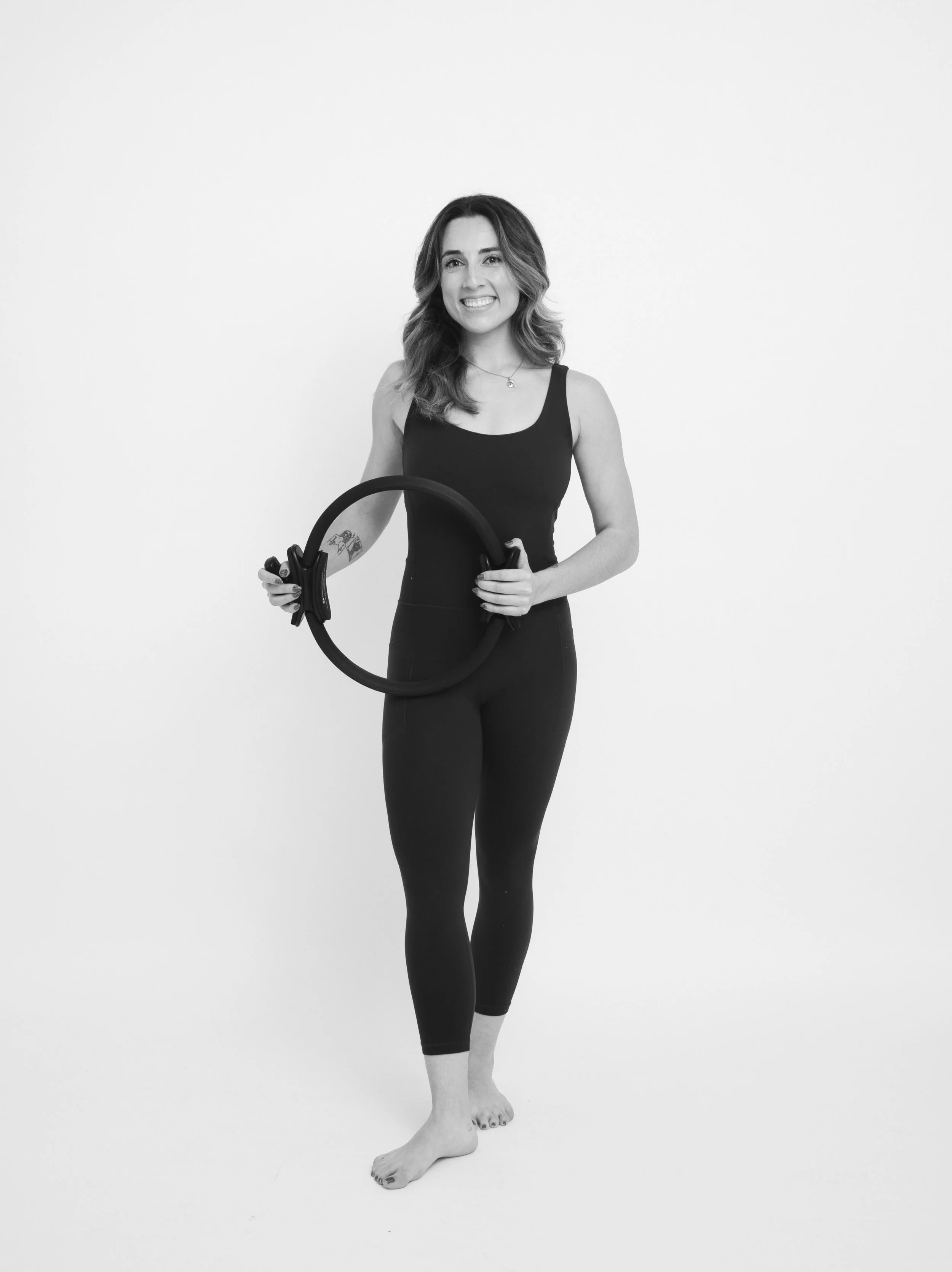
I'm Gina, a Classical Pilates instructor and long-distance runner based in San Francisco. I believe the best training doesn't just make you stronger—it teaches you how to understand the body you're asking to perform. My approach is technical, curious, and deeply rooted in the Classical method, using Pilates to develop the strength, mobility, coordination, and control that carry into everything you love to do. Running is where I get to feel that work come alive—and I want to help you experience that connection between the Mat and your miles, too.